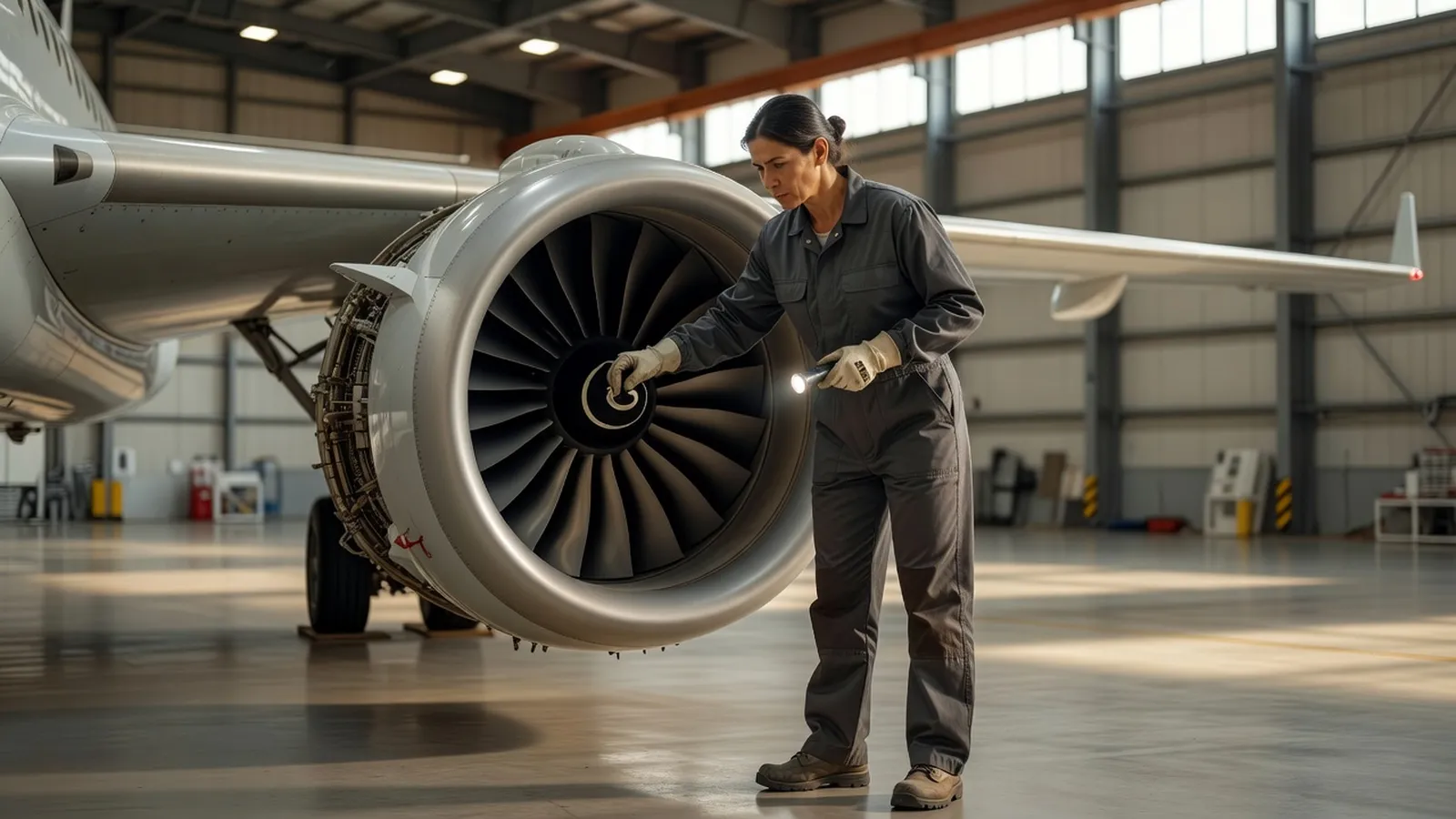
Aerospace careers in Canada can begin with hands-on vocational training, a technical college DEC, or regulated flight and maintenance licensing. In Quebec, a DEP can prepare you for aircraft assembly or manufacturing work, while ÉNA's technical DEC programs focus on avionics, aircraft maintenance and aerospace engineering technology. Pilots and aircraft maintenance engineers follow additional Transport Canada requirements for licences and ratings. Verified on November 25, 2026.
Aerospace work extends beyond the cockpit
Aerospace is not one job family. It includes aircraft maintenance, avionics, manufacturing, structural assembly, machining and flight operations. It also includes support functions that help technical teams train, document procedures and maintain operational knowledge. Quebec's aerospace workforce sector committee, CAMAQ, identifies aerospace as covering manufacturing, maintenance, air transport and airport-related activity. CAMAQ describes its sector role. Verified on November 25, 2026.
For someone like Maya, who enjoys diagnosing equipment and reading technical diagrams, avionics may be a better fit than flying. For Jordan, who prefers precise physical work with tools, drawings and measurements, structural or mechanical assembly may be more suitable. A career decision is easier when you start with the daily work rather than the name of a credential. EduPlus's program-selection guide can help you compare interests, learning preferences and training formats. Verified on November 25, 2026.
Aircraft maintenance work centres on inspection, servicing, troubleshooting and repair. Depending on the role and workplace, the work can involve mechanical components, electrical systems, aircraft structures or records supporting maintenance decisions. Transport Canada distinguishes AME ratings such as M1 for small aircraft, M2 for large aircraft, E for avionics and S for structures. Transport Canada's AME licensing overview sets out these categories. Verified on November 25, 2026.
Manufacturing and assembly roles have a different starting point. An assembler may work from production drawings, prepare components, install fasteners, inspect completed work or assemble cable and circuit systems. A machinist may make or modify precise parts using machine tools and inspection methods. These roles can sit close to aviation, but a manufacturing credential is not itself a pilot or AME licence. The distinction matters when comparing vocational training options in Quebec. Verified on November 25, 2026.
Specialized work around aviation can also appeal to people who prefer planning, communication or instructional design. Training-device support, simulation support, training coordination and technical documentation all contribute to safe, consistent work without placing a person in a cockpit or on a maintenance floor every day. These roles require careful interpretation of procedures, clear writing and attention to how people learn and apply technical information. Verified on November 25, 2026.
Start with the route that matches the work
In Quebec, the main education routes discussed in this guide are the DEP, the DEC and Transport Canada licensing. A DEP, or Diploma of Vocational Studies, is a practical vocational credential. A DEC, or Diploma of College Studies, includes technical college programs and may also support later university study. Transport Canada licences are separate federal credentials for regulated aviation activities. This overview of DEP vocational diplomas explains where vocational education fits within Quebec's system. Verified on November 25, 2026.
The École nationale d'aérotechnique, commonly called ÉNA, lists three technical DEC programs that correspond to major aerospace work areas. The official program titles are in French because the programs are offered in that language. Its prospectus states that the avionics, aircraft maintenance and aerospace engineering technology programs are recognized by Transport Canada, and that the three programs can lead to university studies. Verified on November 25, 2026.
| Training route | Official program name | Code | Published duration | Main focus |
|---|---|---|---|---|
| Technical DEC at ÉNA | Techniques d'avionique | 280.D0 | 3 years | Inspection, troubleshooting, repair and installation of aircraft electrical, electronic, communication and navigation systems |
| Technical DEC at ÉNA | Techniques de maintenance d'aéronefs | 280.C0 | 3 years | Maintenance, inspection and repair of aircraft and helicopter mechanical components |
| Technical DEC at ÉNA | Techniques de génie aérospatial | 280.B0 | 3 years | Design, manufacturing and production planning for aerospace components and structures |
| DEP pathway | DEP Usinage (Machining) | Not stated in the cited source | 1,800 hours | Precision manufacturing skills relevant to aerospace production |
| DEP pathway | Aircraft Structural Assembly | 5697 | 975 hours | Aircraft and aerospace structural assembly |
| DEP pathway | Aircraft Mechanical Assembly | 5807 | 1,185 hours | Mechanical assembly for aircraft production |
| DEP pathway | Cable and Circuit Assembly | 5384 | 840 hours | Cable and circuit assembly for manufacturing contexts |
Source: ÉNA prospectus, Inforoute FPT: Aircraft Structural Assembly, Inforoute FPT: Aircraft Mechanical Assembly, Inforoute FPT: Cable and Circuit Assembly, and CAMAQ annual report, verified on November 25, 2026.
The table is a planning tool, not a list of guaranteed offerings or admissions outcomes. Program availability, application procedures, language requirements and local schedules can change by institution. For example, Alex may use the table to identify the difference between structural assembly and avionics, then check the current details directly with the institution or the official program directory before applying. Verified on November 25, 2026.
College technical education may suit you if you want substantial technical theory alongside lab, shop or applied learning. Quebec's DEC system is different from a university degree: it is a college credential with general education and program-specific study. Verified on November 25, 2026.
Assembly and manufacturing: practical entry points
A vocational route can be a sensible choice if you want to develop production skills in a defined trade. Aircraft structural assembly involves work on aircraft structures. Mechanical assembly focuses on components and mechanical systems used in manufacturing. Cable and circuit assembly concentrates on electrical connections and related assembly tasks. Inforoute FPT lists these as vocational programs in Quebec's mechanical manufacturing sector. Verified on November 25, 2026.
The work itself is methodical. A structural assembler may interpret a drawing, prepare materials, position a component, complete an assembly step and check it against required specifications. A cable and circuit assembler may follow an approved layout, prepare connections and verify that a completed assembly matches the documentation. These jobs reward patience and consistency as much as manual dexterity. CAMAQ's training inventory includes cable and circuit assembly among aerospace-related training options. Verified on November 25, 2026.
When comparing DEP options, look beyond the title. Ask what equipment is used for instruction, how much time is dedicated to drawings and measurements, whether work placements are part of the local delivery model, and what language is used in technical materials. Priya, for example, may be drawn to the word "aerospace" but discover that machining offers the kind of precision and problem-solving she wants. Verified on November 25, 2026.
Useful questions to bring to an information session include:
- What tasks will I practise in workshops or labs?
- Which safety, drawing-reading and quality-control skills are part of the program?
- What are the current admission requirements and application dates?
- Does the program lead mainly to production, assembly, inspection or maintenance-related work?
- What additional workplace training might an employer require?
The structural-assembly program listed by Inforoute FPT states that applicants need a Secondary School Diploma, a recognized equivalent or a postsecondary credential such as a DEC or bachelor's degree. Requirements for other programs should be checked individually rather than assumed to be identical. Verified on November 25, 2026.

Maintenance and avionics: training before licensing
Maintenance and avionics have a strong practical component, but they also involve regulated standards. A person may work in a maintenance environment before becoming licensed, while specific certification privileges require the appropriate Transport Canada AME licence. Transport Canada states that applicants must complete applicable basic training, obtain required experience, complete technical and regulatory examinations, and apply for experience and skill evaluation. Verified on November 25, 2026.
For the M1, M2 and E AME ratings, Transport Canada lists 1,000 hours of applicable basic theory training. For the S rating, it lists 550 hours of aircraft-structures theory training. Basic training must be completed through an acceptable aircraft-maintenance training course unless an applicable exception under Chapter 566 applies. Chapter 566 of the Airworthiness standards provides the regulatory framework. Verified on November 25, 2026.
ÉNA's Techniques de maintenance d'aéronefs program is oriented toward mechanical aircraft and helicopter components. Its Techniques d'avionique program focuses on electrical, electronic, communication and navigation systems. Samira may choose between them by considering whether she would rather diagnose a communication-system fault or inspect and repair a mechanical component. The choice is about the work you want to learn, not just the credential title. EduPlus's guide to pre-university and technical DEC options explains how these college credentials differ from university study. Verified on November 25, 2026.
An AME application also requires documented maintenance tasks that show skill. Transport Canada assesses experience separately against total, specialty and civil-aviation requirements. This is why students should treat records, supervision and task documentation as part of their professional learning from the beginning. The AME requirements table explains this separate assessment approach. Verified on November 25, 2026.
For M1, M2 and E ratings, the published experience framework includes 48 months of total experience, 12 months in the specialty and 6 months of civil-aviation experience. For the S rating, the framework lists 36 months of total experience, 24 months in the specialty and 6 months of civil-aviation experience. Approved basic training may provide experience credit, subject to Transport Canada's rules. Verified on November 25, 2026.
Transport Canada sets a passing grade of 70% for its technical examinations. It also states that the regulatory examination must be completed within 12 months after Transport Canada accepts an application. These are licensing requirements, not general school grading rules, so candidates should consult the current federal information before planning an application. Verified on November 25, 2026.
Flying careers follow a separate federal path
Pilot training is distinct from technical maintenance and manufacturing training. A pilot develops flight skills, aviation knowledge, decision-making, navigation and communication abilities, then applies for the licence or rating that fits the intended flying privileges. Part IV of the Canadian Aviation Regulations governs flight crew permits, licences and ratings. Verified on November 25, 2026.
The published minimums below are useful orientation points for aeroplane licences. They do not replace the full requirements for medical fitness, knowledge examinations, flight tests, language requirements or any additional ratings. A pilot school may organize training differently, but it cannot replace the federal standards that apply to a licence application. Verified on November 25, 2026.
| Aeroplane licence | Minimum age | Core flight-experience requirement |
|---|---|---|
| Private Pilot Licence | 17 years | 45 hours of flight training and experience |
| Commercial Pilot Licence | 18 years | 200 hours total aeroplane flight time, including at least 100 hours as pilot-in-command and 20 hours of cross-country pilot-in-command time |
| Airline Transport Pilot Licence | 21 years | 1,500 hours total flight time, including at least 900 hours in aeroplanes |
Source: Transport Canada Standard 421: Flight Crew Permits, Licences and Ratings, verified on November 25, 2026.
Quebec's Techniques de pilotage d'aéronefs DEC has program code 280.F0 and is listed in the transport sector. Inforoute FPT identifies offerings at Cégep de Chicoutimi, Collège Mérici and Collège Air Richelieu. The program is a college path; the Transport Canada licence remains subject to the applicable federal licensing requirements. Inforoute FPT's program record should be checked for current group and delivery information. Verified on November 25, 2026.
Medical certification is another part of pilot licensing. Transport Canada recognizes medical certificate categories 1, 2, 3 and 4. Category 1 supports Commercial Pilot Licences and Airline Transport Pilot Licences; the applicable medical requirements depend on the permit or licence sought. Transport Canada's medical certificate categories is the appropriate starting point for current information. Verified on November 25, 2026.
A student such as Noah might first explore whether he enjoys structured flight instruction and the responsibilities of aviation decision-making before selecting a college or flight-school route. He should also compare the practical commitments: flight availability, medical requirements, study time, examination preparation and the experience required for the licence level he intends to pursue. Verified on November 25, 2026.
Build a realistic training plan
A strong plan begins with the credential required for the role, then works backward to identify prerequisites, application steps and licensing obligations. If your target is aircraft assembly, begin with vocational options. If your target is avionics or maintenance, compare college technical training with the AME licensing route. If your target is flying, examine the federal licence pathway before choosing a training provider. Verified on November 25, 2026.
Use official sources to confirm details that can change. Admission requirements are set by the institution or program authority. Licence requirements are set by Transport Canada. A training organization can explain its own delivery model, but it cannot guarantee that a student will receive a federal licence. Keeping those responsibilities separate will help you ask clearer questions. Verified on November 25, 2026.
If you completed previous studies outside Canada, collect transcripts, course descriptions and proof of completed credentials before asking an institution how it will assess your education. The assessment process depends on the organization and the purpose of the assessment. EduPlus's guide to foreign credential recognition explains the documents that are commonly useful when you begin that process. Verified on November 25, 2026.
A practical checklist can keep your research focused:
- Identify the work setting you prefer: hangar, production floor, technical office, classroom support or flight operations.
- Compare DEP, DEC and licensing requirements separately.
- Confirm current admission conditions with each school or college.
- Read the current Transport Canada standards if your goal involves flying or AME licensing.
- Keep records of completed training, supervised tasks and relevant experience.
- Reassess your plan after visits, information sessions or conversations with program staff.
This approach also makes room for changes. For example, Elena may start with a DEP because she wants to enter a production environment, then later decide to pursue further technical studies. Another learner may begin with a DEC because avionics theory and troubleshooting are the clearest match for their strengths. Neither route is automatically better; the useful route is the one that matches the work you intend to do. Verified on November 25, 2026.
Careers around aviation operations and learning
Not every aerospace role involves building, repairing or flying an aircraft. Organizations also need people who can prepare technical documentation, organize training records, coordinate competency tracking, support instructors or help maintain training devices and simulations. These functions are closely connected to technical operations because they translate procedures into usable learning and reference material. Verified on November 25, 2026.
Technical documentation work can suit someone who combines strong writing with an interest in procedures. The person may help structure manuals, update maintenance-related records or make complex instructions easier to follow. Accuracy matters because the document needs to reflect the applicable procedure, terminology and revision process. Verified on November 25, 2026.
Training coordination is another adjacent path. It can involve scheduling, maintaining records, tracking completed learning activities and helping ensure that workers receive the training assigned to their role. The work is administrative and technical at the same time: a coordinator needs to understand why currency, documentation and competency records matter in regulated or safety-sensitive environments. Verified on November 25, 2026.
Simulation and training-device support can bring together equipment knowledge, instruction and troubleshooting. Rather than assuming that a particular technology is required, focus on transferable abilities: following procedures, identifying faults, communicating with instructors and documenting changes carefully. These skills can be developed through technical education, workplace experience and related support roles. Verified on November 25, 2026.
Common questions
Does an ÉNA DEC automatically issue an AME licence?
No. ÉNA's relevant DEC programs can provide recognized technical training, but an AME licence is issued by Transport Canada only after the applicable training, experience, examination and skill-evaluation requirements are met. Verified on November 25, 2026.
Is avionics the same as aircraft maintenance?
Avionics is a specialized area involving aircraft electrical, electronic, communication and navigation systems. Aircraft maintenance can include mechanical, structural and powerplant-related work as well as other maintenance activities. Transport Canada treats avionics as the E AME rating area. Verified on November 25, 2026.
Can a DEP lead directly to a pilot licence?
No. A DEP can provide vocational training in a manufacturing or assembly field, but a pilot licence requires the flight training, examinations, flight test, medical certification and experience set by Transport Canada. Verified on November 25, 2026.
How old must you be for a private aeroplane pilot licence?
Transport Canada Standard 421 sets the minimum age for a Private Pilot Licence - Aeroplane at 17 years. The same standard sets 18 years for a Commercial Pilot Licence - Aeroplane and 21 years for an Airline Transport Pilot Licence - Aeroplane. Verified on November 25, 2026.
Can technical aerospace studies lead to university?
ÉNA's prospectus states that its three technical DEC programs can lead to university studies. University admission decisions and prerequisite requirements remain the responsibility of the receiving institution. Verified on November 25, 2026.
Learn more
Start by comparing the vocational programs listed above if you are considering assembly, machining or production work. If you are returning to education after time in the workforce, EduPlus's guide to adult AEC study can help you compare college-based continuing education with other routes. For pilot and AME licensing, always confirm the current requirements directly in the applicable Transport Canada standards. Verified on November 25, 2026.